
On This Day - 31st January
1606 Guy Fawkes, one of the conspirators in the Gunpowder Plot, was hanged, drawn
and quartered. Known as Guido Fawkes, the name he adopted while fighting for the Spanish in the Low Countries,
Fawkes belonged to a group of provincial English Catholics who had planned the failed Plot in November 1605. Guy
Fawkes was born at Stonegate in York, (see
Guy Fawkes, one of the conspirators in the Gunpowder Plot, was hanged, drawn
and quartered. Known as Guido Fawkes, the name he adopted while fighting for the Spanish in the Low Countries,
Fawkes belonged to a group of provincial English Catholics who had planned the failed Plot in November 1605. Guy
Fawkes was born at Stonegate in York, (see 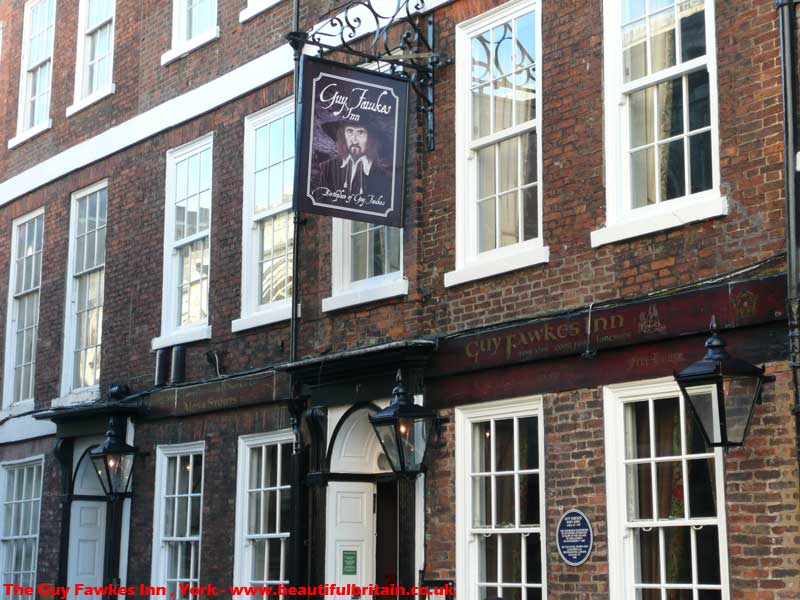 picture), in April, 1570.
1788Death, in Rome, of Charles Edward Stuart (Bonnie Prince Charlie). After his
father's death, Charles was recognised as 'King Charles III' by his supporters.
1849The abolition of the Corn Laws. These trade barriers had been designed to
protect cereal producers in the United Kingdom against competition from less expensive foreign imports and their
abolition marked a significant step towards free trade.
1858The Great Eastern, the five-funnelled steamship designed by Isambard Kingdom
Brunel and John Scott Russell, was launched at Millwall. At the time, it was the world's largest ship.
1867The four bronze lions at the base of Nelson's Column were completed.
1910American-born murderer Dr. Hawley Crippen poisoned his wife before cutting
her into small pieces and burying her in the cellar of his home in London. He was later executed at Pentonville
Prison.
1917As World War One raged, Germany announced that submarine warfare would
resume the next day, following a two-year break.
1918A series of accidental collisions on a misty night, off the Isle of May at
the entrance to the Firth of Forth, led to the loss of two Royal Navy submarines and damage to another five British
warships. In all 270 people lost their lives.
1919The Battle of George Square took place in Glasgow. Known as Bloody Friday
and Black Friday, it was one of the most intense riots in the history of Glasgow. The dispute revolved around a
campaign for shorter working hours, backed by widespread strike action. Clashes between the City of Glasgow Police
and protesters broke out, leading to the British government sending soldiers and tanks to the city to prevent any
further gatherings.
1931Christopher Chataway, former British athlete & Conservative MP, was
born.
1953307 people were killed when the Thames estuary broke its banks, flooding
large areas of Kent and Essex. A car ferry also sank in the Irish Sea, in one of the worst gales in living memory,
claiming the lives of more than 130 passengers and crew.
1981Former British MP John Stonehouse, famous for faking his own death, married
his former secretary Sheila Buckley.
1983It became compulsory in Britain to wear car seat belts.
1994German based BMW bought the Rover Group from British Aerospace for for
£800,000,000 (£800M) then sold Land Rover alone for £1,800,000,000(£1.8Bn). A good purchase
then for BMW!
2000Family GP Dr. Harold Shipman was jailed for life for murdering 15 of his
patients, making him Britain's most prolific convicted serial killer. An official inquiry concluded that Shipman
may have killed as many as 250 patients over 23 years.
2016 The death of the radio and TV brodcaster Terry Wogan, aged 77. He presented Children in Need, Wake Up to Wogan, Come Dancing, the game show Blankety Blank and he was the BBC's commentator for the Eurovision Song Contest from 1971 to 2008. His weekday radio programme on BBC Radio 2, 'Wake Up to Wogan', had eight million regular listeners, making him the most listened to radio broadcaster in Europe. He was granted a knighthood in 2005 and was entitled to use 'Sir' in front of his name as he held dual British and Irish citizenship.
2020 At 11pm Greewich Mean Time, the United Kingdom leaves the European Union, following the referendum of 23rd June 2016 in which 51.9% of voters elected to leave. It took three years, resulted in two general elections and three prime ministers. The transitional period will last until the end of 2020, unless the government and the EU agree a new deal before then. During this 11-month period, the UK will continue to follow all of the EU's rules and its trading relationship will remain the same.