
On This Day - 6th August
1504 Matthew Parker, archbishop of Canterbury was born. He had an extremely
long nose and was extremely inquisitive, hence the expression 'Nosy Parker'.
Matthew Parker, archbishop of Canterbury was born. He had an extremely
long nose and was extremely inquisitive, hence the expression 'Nosy Parker'.
1623Anne Hathaway, wife of William Shakespeare died. See 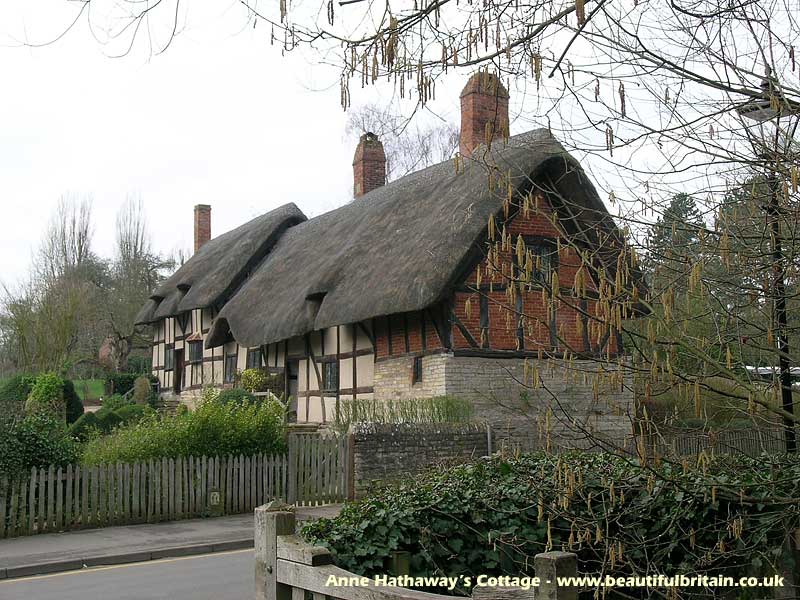 picture of Anne Hathaway's Cottage at Shottery, one mile west of Stratford upon Avon.
1809Alfred Tennyson, English poet was born. He is the second most frequently quoted writer in The Oxford Dictionary of Quotations, (after Shakespeare). Tennyson wrote a number of phrases that have become commonplaces of the English language, including "Better to have loved and lost than never to have loved at all", and "Theirs not to reason why, theirs but to do and die".
1844The first UK press telegram was sent, to The Times, announcing the birth
of Prince Alfred to Queen Victoria.
1880In a remarkable race at the Astley Stakes
in Lewes, East Sussex, 5 of the 9 horses passed the winning post virtually simultaneously. The judge declared a triple dead heat for first place, with a double dead heat for fourth.
1881Sir Alexander Fleming, scientist, Scottish bacteriologist and discoverer
of penicillin was born here - Lochfield Farm (see  picture), at Darvel in Ayrshire. His 'bacteria killer' discovery changed the world of modern medicine and has saved millions of people around the world.
1889The Savoy Hotel in London was opened.
1914World War I: The first Battle of the Atlantic took place On This Day. Two days after war had been declared war on Germany over their invasion of Belgium, ten German U-boats left their base in Helgoland to attack Royal Navy warships in the North Sea.
1922The birth of Sir Freddie Laker, British airline entrepreneur, best known for founding Laker Airways in 1966. He was one of the first airline owners to adopt the 'no-frills' airline business model.
1934Chris Bonington, British mountaineer was born. His career included nineteen expeditions to the Himalayas, including four to Mount Everest and the first ascent of the south face of Annapurna, in Nepal.
1949The 'acid bath murderer' John Haigh was executed. He was convicted of the murders of six people, although he claimed to have killed a total of nine, dissolving their bodies in concentrated sulphuric acid before forging papers in order to sell their possessions and collect substantial sums of money.
1962Jamaica became independent, after being a British colony for 300 years.
1971Chay Blyth became the first to sail the world solo, non-stop, in the "wrong" direction
i.e. east to west - against the prevailing winds and currents. His journey
took 292 days.
1976The government passed the Drought Act to combat the continued UK drought.
1987SDP leader Dr David Owen resigned after members of his party
voted to merge with the Liberals.
1990Gulf War: The United Nations Security Council ordered a global trade embargo against Iraq in response to Iraq's invasion of Kuwait.
2009The funeral service took place at Wells Cathedral for Britain's last World War I veteran Harry Patch, aged 111. See  picture of the memorial at Wells Cathedral.
2012Pioneering astronomer and physicist Sir Bernard Lovell, the founder of University of Manchester's Jodrell Bank Observatory died, aged 98. The main telescope at Jodrell Bank (see  picture) is known as the Lovell Telescope.